 Add to Chrome
 Add to Firefox
 Add to Edge
Towards Robust Text-to-Image Person Retrieval: Multi-View Reformulation for Semantic Compensation
Apr 20, 2026
In text-to-image person retrieval tasks, the diversity of natural language expressions and the implicitness of visual semantics often lead to the problem of Expression Drift, where semantically equivalent texts exhibit significant feature discrepancies in the embedding space due to phrasing variations, thereby degrading the robustness of image-text alignment. This paper proposes a semantic compensation framework (MVR) driven by Large Language Models (LLMs), which enhances cross-modal representation consistency through multi-view semantic reformulation and feature compensation. The core methodology comprises three components: Multi-View Reformulation (MVR): A dual-branch prompting strategy combines key feature guidance (extracting visually critical components via feature similarity) and diversity-aware rewriting to generate semantically equivalent yet distributionally diverse textual variants; Textual Feature Robustness Enhancement: A training-free latent space compensation mechanism suppresses noise interference through multi-view feature mean-pooling and residual connections, effectively capturing "Semantic Echoes"; Visual Semantic Compensation: VLM generates multi-perspective image descriptions, which are further enhanced through shared text reformulation to address visual semantic gaps. Experiments demonstrate that our method can improve the accuracy of the original model well without training and performs SOTA on three text-to-image person retrieval datasets.

CCUP: A Controllable Synthetic Data Generation Pipeline for Pretraining Cloth-Changing Person Re-Identification Models
Oct 17, 2024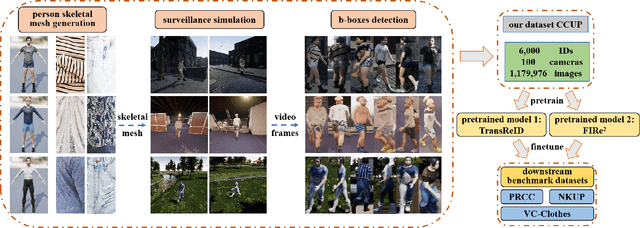


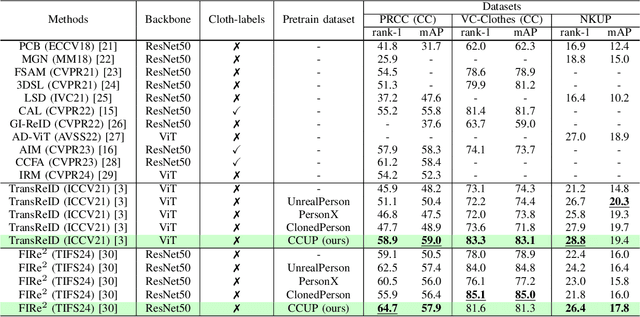
Cloth-changing person re-identification (CC-ReID), also known as Long-Term Person Re-Identification (LT-ReID) is a critical and challenging research topic in computer vision that has recently garnered significant attention. However, due to the high cost of constructing CC-ReID data, the existing data-driven models are hard to train efficiently on limited data, causing overfitting issue. To address this challenge, we propose a low-cost and efficient pipeline for generating controllable and high-quality synthetic data simulating the surveillance of real scenarios specific to the CC-ReID task. Particularly, we construct a new self-annotated CC-ReID dataset named Cloth-Changing Unreal Person (CCUP), containing 6,000 IDs, 1,179,976 images, 100 cameras, and 26.5 outfits per individual. Based on this large-scale dataset, we introduce an effective and scalable pretrain-finetune framework for enhancing the generalization capabilities of the traditional CC-ReID models. The extensive experiments demonstrate that two typical models namely TransReID and FIRe^2, when integrated into our framework, outperform other state-of-the-art models after pretraining on CCUP and finetuning on the benchmarks such as PRCC, VC-Clothes and NKUP. The CCUP is available at: https://github.com/yjzhao1019/CCUP.